Showing posts with label testing. Show all posts

Wednesday, October 29, 2014

An Oldie, but a Goodie...Field Testing Frame Differences with a Power Meter


I originally posted this back in 2008 on the Slowtwitch.com forum and is an example of the types of equipment differences that can be determined with careful field testing.  Here's the link (click on the title below) to the full thread on Slowtwitch...it's long but informative, and there's some pretty good "back and forth" with a few skeptics:

Something Borrowed...Something Fast!

 
So take this guy and his position:


...and put him on this guy's bike and adjust it so that they fit identical.


Then, let the first guy test both of these "back to back" using the same 404 wheelset with PT SL hub and cover....Any guesses on what the aerodynamic drag differences (if any) one would see?

Using RChung's most excellent methodology described here: Method to the madness

Here's the results for the P2K with the 404 wheels (the wheels on the P3C above):


And here's the results for the P3C:


So...what's the bottom line?

Well...taking the same rider, the same wheels, the same basebars and brake levers, and with the seat and extensions adjusted to deliver the same positions...at basically zero yaw conditions I apparently measured a drag difference of ~.023 m^2 of CxA (or Cda, whichever you prefer - .228 m^2 for the P2K and .205 for the P3C). Using Doc C's "rule of thumb", that basically equates to ~2.5s per km of time savings.

With only an extremely small amount of crosswind however (I could just barely detect it on my skin, not enough to even move leaves on trees), the drag on both setups drops significantly, with the P3C setup dropping more at .190 m^2 vs. the P2K's .220 m^2 for a growing difference of ~.03 m^2. That translates to a difference of ~3 seconds per km...or a full 2 minutes over 40K.

Can you imagine comparing the difference between a P3C (or even the P2K) against a frame that actually increases in CxA with increasing yaw, which is actually fairly common?

Friday, August 29, 2014

Some more Conti Crr data

I often get asked about how some of the other Continental tires roll, such as the Attack/Force models, and the 23C version of the SuperSonic tire. Well, thanks to Eric Reid (who sent me a new Attack and a slightly used Force) along with Thomas Gerlach (who sent me a VERY well used 23C SuperSonic) I know have a couple of those data points.

To be clear on the SuperSonic, when I say very well used, I mean VERY well used...according to Thomas, this tire has ~600-1000 miles on it of rear tire used.  When mounted on my Mavic Open Pro test rim and inflated to 120 psi, I measured a flat section on the tread that was a full 7mm across. In other words, it was near "end of life" ;-)

So, without further ado, here are their results:

Continental Supersonic 23C (WELL worn) = .0027, 25W for pair @ 40kph
Continental Attack 22C = .0035, 32W for pair @ 40kph
Continental Force 24C = .0029, 27W for pair @ 40kph

By comparison, here's the results for the "benchmark" GP4000S:

Continental GP4000S 23C = .0034,  31W for pair @ 40kph

My suspicion is that a new 23C Supersonic would probably test out closer to .0030.  The worn Crr result puts it currently at the top of my Crr chart, but with a hefty asterisk.

The result for the Attack model shows it to roll about the same as (or just slightly worse than) the GP4000S, but with its narrower profile (22.7mm vs. 24.2mm) it should be slightly more aerodynamic.  The Force model rolled very well, although it too had a small amount of miles on it.  It basically put it in a tie, or slightly behind the top mark for a brand new tire I've tested, the Specialized Turbo Cotton. However, it also measured a fairly wide 25mm on my narrow test rim. On a wider rim, such as a Zipp Super9 disc, it would most likely measure as much as 26mm.

The spreadsheet linked to in the upper right of this blog has been updated to include these results.


Tuesday, July 15, 2014

There's a new Sheriff in town...


If you check the link to the overall Crr spreadsheet in the upper right of this blog, you'll see that there's a new top entry.  It's the tire pictured above, the Specialized Turbo Cotton 24C which was introduced today. It sits firmly at the top of my list of production tires I've personally tested on the rollers, with a predicted on-road Crr of .0029, as compared to the Crr of .0031 for a trio of tires that used to be in a virtual tie (the Vittoria EVO Open Corsa Triathlon 22C, the Vittoria EVO Open Corsa Slick 23C, and the Schwalbe IronMan 22C Tubular).

The fact that it's so well rolling is not surprising considering it's construction. Like those other 3 tires, it's based on a 320tpi cotton casing. The main difference from those other tires is, of course, the tread that's glued onto it, which in this case is made from Specialized's proprietary Gripton material that they introduced last year with the S-Works Turbo tire. I've found this compound to truly live up to it's name, as can probably be guessed by the amount of wear on the labeling in the picture above.

OK...great...so it rolls really well (~4W less for a pair @40kph as compared to the "benchmark" Continental GP4000S) and rides/handles great, but is it aero?  Or, at least "aero enough"?  As I've written before, Crr can make up for a great deal of aerodynamic "sins" http://bikeblather.blogspot.com/2013/04/why-tire-crr-matters.html . Is the Turbo Cotton at least aero enough to take advantage of its ultra-low Crr to make it a good choice when aero is of a concern?  Apparently...yes.

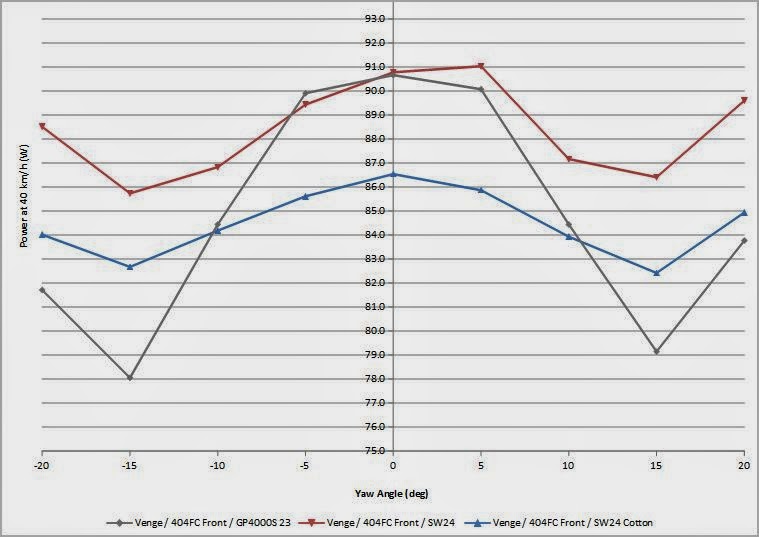
In interactions with the folks at Specialized, I was given a spreadsheet that shows the drag data for a test run taken with Zipp 404FC clinchers in a Venge road bike.  The tires tested were the S-Works Turbo, the Turbo Cotton, and the Continental GP4000S 23C, which has been shown to have excellent aerodynamics on a variety of wheels. The plot of CdA vs. yaw angle is shown below:


As you can see, it shows that the Turbo Cotton is basically tied with the GP4000S at low yaw angles (up to 5deg), but then the GP4000S results in up to .010 m^2 lower CdA at 15deg of yaw. It's also interesting that the S-Works Turbo appears to be more aero than the Turbo Cotton. This could perhaps be because of the "lip" at the interface of the glued-on tread and the casing on the Turbo Cotton.

Another way of looking at this is by combining the Crr results with the aero results.  Here's what the combined power would be for 40kph (85kg load).  As can be seen, the low Crr certainly helps the Turbo Cotton beat the GP4000S all the way out to 10deg, while at 15deg of yaw the Conti actually beats it by ~3-5W. Above 15deg, the margin narrows again.


Well...it's pretty fairly obvious what I would do with this right?  Time to analyze the combined aero+rolling drag for a weighted average of yaw angle, like was done in the blog post I linked to above.  In short, here's how that turned out (using the Crr from my own roller measurements):


What does that mean?  Well, using the Mavic generated wind yaw angle weighting (as in the previous analyses), it shows that the excellent Crr of the Turbo Cotton tire overcomes the lesser aerodynamic performance at higher yaw angles (as compared to the GP4000S), at expected apparent wind speeds up to >50 kph.  And it stays faster than the S-Works Turbo all the way up to apparent wind speeds of 60kph.  Fairly impressive.

I've ridden a pair of these tires on my road bike for the past few weeks...and I have to admit that I've found my new favorite "all around" tire for racing.  It's a no-brainer selection for road races and crits due to its naturally (because of the construction) good ride quality and cornering grip (because of the tread compound). I've yet to TT on these tires...but it's pretty tempting. They seem to work fairly well for Tony Martin for that purpose. Then again, I have a feeling Tony Martin's average apparent wind yaw angle is pretty darned low :-)

Sunday, July 6, 2014

Crank Length? Whatever...(within reason)


 Discussions about bicycle crank length have been a fairly hot subject recently. There's a trend in TT/Tri circles to use shorter than "normal" crank lengths. This is done to allow folks to either open up the distance between their torso and leg at the top of the pedal stroke (to be better able to produce power) and/or allow them to lower the angle of their torso relative to the ground in an attempt to get more aerodynamic. Sometimes it's done for both. One thing that is commonly brought up is questions about how using shorter (or longer) than normal cranks affects sustainable power output. Does it...or not?

There's a lot of data out there showing that wide variations in crank length do not have significant effects on  power output, such as the work done by Jim Martin at the University of Utah, summarized here: http://www.plan2peak.com/files/32_article_JMartinCrankLengthPedalingTechnique.pdf

From that presentation, "170mm cranks would compromise the power output of the shortest and tallest riders by AT MOST 0.5%. For example 6 watts out of 1200"

Another takeaway: "Crank length and pedaling rate influence metabolic cost and efficiency only by influencing pedal speed."

How can that be? Doesn't it logically make sense that for an optimum setup, a person needs a crank length proportional to their leg length?  For example, there are websites out there that claim to identify the "ideal" crank length for a given person (http://www.nettally.com/palmk/crankset.html). However, one thing that most folks miss on that site is that the lengths of cranks recommended with that method uses an underlying assumption with no apparent basis, i.e. "The standard crank length of 170mm is optimum for a cyclist with a 31-inch inseam." The entire method is anchored in that assumption...and yet, the Martin study summary I linked to above shows that power production is relatively unaffected over a wide range of crank lengths for a wide range of leg lengths. Is there an optimum?  Perhaps...but, even if there is, the Martin data shows that varying from that optimum (even by relatively large amounts) doesn't appreciably affect power output.


But, doesn't a shorter or longer crank affect your "leverage"? Sure...but that difference in leverage can be compensated for elsewhere in the drivetrain. The crank isn't the ONLY lever between your foot and the ground. The gears themselves, along with the rim and tire diameter are also "levers", which can be varied. One thing to keep in mind is that physiologically, our muscles have a preferred shortening speed, which results in a preferred foot speed at the pedal. I'm not talking about cadence...I'm talking about the tangential velocity that the foot travels at during the power production (i.e. downstroke) phase of the pedal cycle.

The Challenge:

A little over a month ago, in a discussion on the Wattage Google Group about the effects of differing crank lengths, the following was posted in response to the idea that changing crank lengths could be "compensated" by varying gearing selections:

"The gearing argument has been raised many times. It's usually raised and argued a lot by people not on the big side of the spectrum,  ie people that are already on somewhat ideal cranks.

My counter argument is this:

If you are riding say 170mm cranks and you firmly believe that gearing can wholly make up for cranks of the wrong size. I encourage you to take the "Pepsi Challenge" that challenge is this:

1: Go TT up your favorite 15 minute or longer hill at LT or greater power (by HILL I mean something with average grade 6% or greater) with your current setup and time it a few times.
2: Then put on crank arms that are only 87.5% in length of your current setup.  That would be 148.75mm if you are currently riding 170s. You now have my proportional experience setup of me riding 175mm cranks.
   Take your own medicine and re-gear appropriately. Now ride that setup for a few weeks and go TT up your favorite hill a few more times and time it.

If you can show me you can do the same time with your medicinal gearing going full tilt, then I'll happily eat some humble pie.


I've offered that challenge for a few years now, and suprisingly enough NO ONE HAS TRIED IT. Go figure.  News flash, I and many other long legged people that have actually taken that "pepsi challenge", have come to the very real conclusion the longer arms are faster. Now we can quibble over why they are, but that's kinda irrelevant, fact is they are.

So I really challenge you or anyone else who is of normal size to take that challenge and see what it's REALLY like to be riding something so far out of what for what your body needs. Been over 5 years since I first offered that challenge, and I'm still waiting for someone of "normal" size to try it out...patiently.

cheers,
-kieran"


https://groups.google.com/forum/#!msg/wattage/kVyNPWvOq7M/iNP0DIn-QWUJ 

Not being one to shy away from a challenge like that...especially since the one doing the challenging is someone I know...I decided to take it up. Luckily, I have a friend (Greg Steele, of Beehive Bicycles in Salt Lake City http://www.beehivebicycles.com/) who let me borrow a set SRM cranks with the adjustable length option.


These cranks allow for an adjustment range of 150-190mm. To do the testing, I decided to use the first 2 miles of a local ~8% average grade hill. From the Kirby Palm "method", I used as the first test a setting of 175mm since that's what his formula claims is the "optimum" for my 32" inseam (as measured per his instructions). In order to ensure that my lowest gearing was as equivalent as possible, I chose a 12-25 cassette for use the 175mm cranks.  Since the crank length was pretty close to my normally used 170mm, all I did for adjustments was lower the saddle slightly. After setting everything up, off I went to the hill and give it "full stick" for my baseline. Here are the results:

Time = 12:50, Power = 289W, Cadence = 73 rpm, HR = 170bpm

For the short crank length, I wanted to use something that was equivalent, or below, the "87.5% below optimum" in the challenge above. For that, I chose 150mm, which is actually only 85.7% of the "optimum" 175mm length. In order to assure nearly equivalent low gearing, I chose a 12-30 cassette to pair with my 39T small ring.

Now then, when making such a large change in crank length, it's important to make sure to maintain the relationships between the saddle, the bars, and the foot during the "power", or downstroke part of the pedal cycle. As such, when I adjusted the crank length from 175mm down to 150mm, I did 2 things with the saddle.  First, I raised the seatpost such that the distance between the portion of the saddle I rest my sitbones on and the pedal at max extension was the same distance, but I ALSO moved the saddle rearward on the rails so that in the end it was a full 25mm further rearward relative to the center of the BB than when the cranks were set at 175mm.  This was done to keep the relationship between my lower leg and the pedal equivalent at the "3 O'clock" portion of the pedal stroke.  Because of the movement in the saddle (both up and rearward), that also meant I need to move the bars the same directions to keep the bar to saddle relationship as close as possible. Luckily, I had a stem handy that was short enough, and with a high enough rise so that I could do this with a fairly simple stem swap.  It wasn't the exact dimensions required, but it was close enough. Shown below is an overlay of the 2 setups.


So...after making the setup change a few days after the baseline run, I then ventured out to the test hill and with the only "accomodation" being the ~15 minute ride over there, I did a run with the 150s.  Here are the results for that:

Time = 12:50, Power = 286W, Cadence = 84 rpm, HR = 171bpm

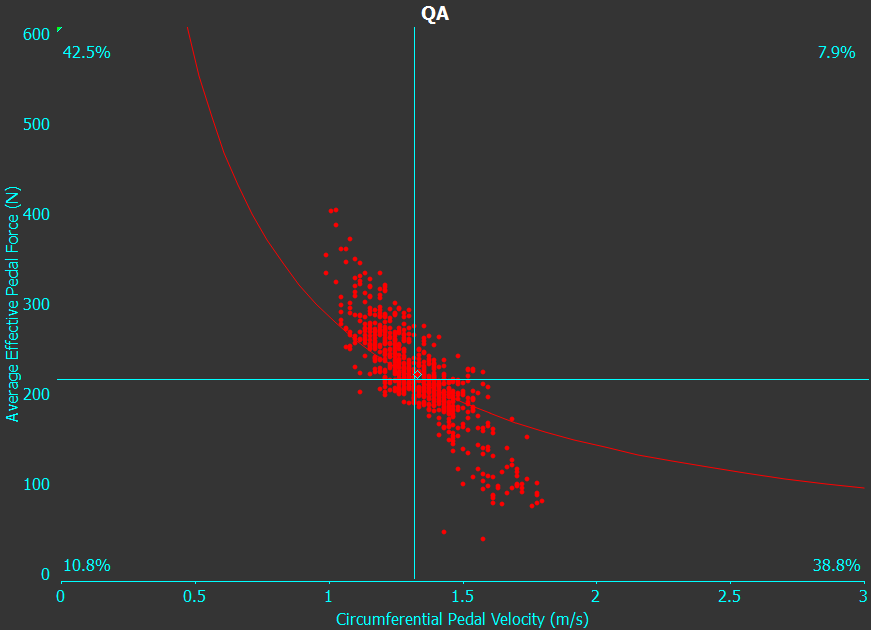
Or...basically the SAME time, power, and HR as the 175mm crank length run. As expected, the cadence increased so that my tangential pedal speed and average pedal force were the same.  This can be easily seen with a Quadrant Analysis plot of each run.

175mm Crank QA

150mm Crank QA

Pretty much identical, no?

Anyway...so what does this all mean?  It means that determining an "optimal" crank length for bicycling isn't very important. Instead of worrying about it from that standpoint, just understand that a wide range of lengths are acceptable, and use it as a "lever" (pun intended) for other things, such as fitting issues. One thing you might want to be wary of is going too large, in that that actually can start causing problems at the top of the pedal stroke and/or prevent the most aero position for a given event. It's somewhat hard to go "too small" (within reason) on crank length...just make sure you're geared adequately for the course profiles.

Oh...and it also means Kieran needs to eat some "humble pie"....nom, nom, nom ;-)

Friday, August 30, 2013

Schwalbe Ironman Tires - A Clincher, A Tubeless, and A Tubular


Update Note: Since the testing of these tires and the publishing of this post, it's come to my attention that Schwalbe has apparently discontinued using latex tubes within their tubular tires. As such, one should expect the tubular version of the IM tire to roll significantly slower than tested below; in the range of 2-4W slower per tire. The tire tested will now be listed in my spreadsheet summary as "Out of Print" - 14 Nov 2015

Earlier this year, Schwalbe announced a set of tires marketed towards the triathlon/TT crowd...in fact, they're branded with the Ironman logo, so it's not too hard to figure out the target market ;-)

Anyway, the interesting thing about this announcement was that it wasn't just a single tire, but actually 3 tires: a clincher, a tubeless, AND a tubular model.  The design goal for this line of tires was to come up with the best combination of tire properties (i.e. Crr, aero, and durability) for going fast (and far) against the clock. For aero, the tires are sized at 22C and have a noticeable parabolic shape.  Additionally, there's a pattern molded into the sides of the tire that is intended to act much like the boundary layer trip features we've seen on tires like the Mavic CXR offerings.

Luckily, I was able to get my hands on a set of these tires and was able to put them on the rollers to see how they do.  Upon first inspection, the clincher and the tubeless tires appeared to be virtually identical, with the tubeless model appearing to have an extra layer molded to the inside (most likely an air barrier layer), so I expected the tubeless to roll slightly worse than the clincher model with a latex tube.  The tubular model is actually a traditional style "sew up" (i.e. a casing with glued on tread, not a 1 piece vulcanized model) with what appears to be a fairly high TPI casing with the a tread cap glued on that looks and feels just like the clincher and tubeless models.

So...how did they roll?  Here's the answers:

Schwalbe Ironman Tubular (22C)   = .0031
Schwalbe Ironman Tubeless (22C) = .0035
Schwalbe Ironman Clincher (22C)  = .0041

Interestingly enough, it appears that the tubeless version has LOWER Crr than the clincher, even with the clincher using a latex tube.  I find that very curious...that means there must be something different about the compounding or the casing with the tubeless, because there's no way an added butyl air barrier layer should be lower loss than a latex inner tube.  In fact, at the time of the testing, the Schwalbe Ironman tubeless model was the fastest rolling tubeless tire I had tested, or even as compared to the tubeless tires Al Morrison has tested in the past.

Curious about what some miles would do to the Crr on the tubeless model, I left it on my rear wheel for just over 300 miles and then retested with the result of:

Schwalbe Ironman Tubeless - w/335 miles = .0033

Now THAT is the fastest tubeless model tire I've tested to date (I've got a bunch of tubeless tires I've been testing and I'll post a "compendium" soon), and the only one close to it is significantly wider (25C vs. 22C).

But, the real eye-opener of the group was the tubular model.  Obviously, we know that the type of tire construction used (high TPI casing, latex tube, etc.) makes for a fast rolling tire.  But, to be able to pull that off with a relatively thick tread cap glued on means that there must be some "magic sauce" in the tread compound.  Of course, the performance of that tire also begs the question of why they just don't make an "open tubular" version of the tire for the clincher market instead of the current clincher...

So, it appears that they've done a good job on the Crr front.  The clincher is on par with tires like the Michelin Pro 4s, the tubeless is pretty fast (slightly faster or slower than a Conti GP4000S, depending on miles), and the tubular is smoking fast as well.  If the aerodynamics comes close to other tire models, these tires would definitely be an intriguing option for TTs and triathlons, especially for folks who plan on going pretty fast and/or in low yaw conditions (because of the relative narrowness) .

Also, as one extra data point on latex vs. butyl, I tested the clincher with a butyl tube instead and here's how it rolled:

Schwalbe Ironman Clincher (22C)  = .0046

Once again, this shows that a butyl tube "costs" ~3W per tire as compared to latex...just sayin'  :-)

The latest overall charts:


Saturday, August 10, 2013

Even more Crr results...and another example of why Crr matters, Mavic edition

I did a short bit of roller testing yesterday.  The main incentive for that was I was able to get my hands on a prototype set of the new Mavic CXR60C clincher wheels and I was itching to see how well the new CXR clincher tire rolls.  Back in May I attended the press introduction for the CXR60 wheel line on behalf of Slowtwitch.com.  You can see my review of the wheels at that time here: Mavic CXR60 Intro.

At the time of the press introduction, none of the attendees were able to ride the clincher version of the wheels, so a big question mark in my mind was how well the tires performed from a rolling resistance standpoint.  From the wind tunnel results, obviously the wheel+tire system performed excellent in regards to aero drag, but I already had experience with the tubular CXR tires and found them to be slow...so much so that they basically "wasted" the aerodynamics.  More on that later.

In any case, here's the results from yesterday's roller testing:

Mavic CXR clincher protoptype (23C) = .0036
Challenge Triathlon clincher (23C)        = .0034
Challenge Triathlon w/Panaracer R'Air =  .0042

Besides the Mavic tires (I tested 2 and they were nearly identical) I also tested a Challenge Triathlon clincher.  Both the Mavic and the first run of the Challenge Triathlon were run with latex tubes, and then I decided to run the Challenge tire again after swapping out the latex tube for a Panaracer R'Air tube.  This tube is a butyl based tube that is advertised to be compounded to be more flexible like a latex tube and I was curious to see if it made any difference in the rolling resistance.  It did...but just barely (~1W for a pair @ 40 kph)...and that improvement is definitely not worth the cost of the tubes, especially considering one can get a latex tube for the same price.

The Mavic tire's Crr of .0036 is a very respectable result...much better than I was anticipating based on what I had measured for the tubular and what the Mavic engineers had claimed the difference was between the tires.  By comparison, the average Crr I've measured for brand new Continental GP4000S tires is only slightly better at .0034, and is significantly better than the Michelin Pro4 Service Course Comps at .0041. Don't forget...for this testing (and the uncertainties involved) I consider anything within .0001 of Crr to be basically "tied".

At the end of the Slowtwitch.com article I linked to above, I had created a chart showing the combined affects of Crr and aero drag like I outlined in a previous blog post (Why Crr Matters...) Shown below is how that chart looks with the measured Crr for the CXR60C prototype tires.


It's fairly obvious from that chart that the CXR60C is the fastest wheel+tire system that Mavic makes.  In fact, the difference for a single front wheel at an expected apparent wind velocity of 40 kph is on the order of 5-6W on average in favor of the CXR60C over both the CXR80 and the CXR60T tubular wheels.

The latest published version of the roller testing Crr spreadsheet can be found in the link at the upper right under "pages".


Sunday, August 4, 2013

Aero Field Testing using the "Chung Method" - How sensitive can it be?


As some of you may know, I've been field testing bike stuff and positioning with a power meter for 4 or 5 years now.  My method of choice is Robert Chung's "Virtual Elevation", or VE protocol, sometimes known as the "Chung Method".  He has a great presentation on it here: http://anonymous.coward.free.fr/wattage/cda/indirect-cda.pdf . When I first read Robert's info, I wrote up a spreadsheet that I've used since then to analyze everything from position changes to tire air pressure effects. Of course, since I wrote that spreadsheet for my own use, it's not exactly the most "user friendly" (Hey, I know what I'm supposed to do, I wrote it! ;-)...but, don't worry, everyone else is in luck since Andy Froncioni (the main tech guy behind Alphamantis and the ERO facility that recently opened at the indoor track in Carson) added a version of the same calculations (called "Aerolab") to the freeware power meter analysis software, Golden Cheetah.

So, the question with this type of testing usually comes down to just how sensitive can it really be...especially as compared to something like a wind tunnel?  Admittedly, there are some limitations to this type of testing, the main one being (at present time) that the results are mostly limited to zero yaw conditions, but as we saw in one of my previous blog posts, the most common yaw angles a TT'er or triathlete encounters are usually centered around zero yaw.  Using the tool to make evaluations at zero yaw still can hold a significant benefit for someone interested in improving/testing bicycle aerodynamics.

A couple years ago, Dr. Andrew Coggan published a blog post titled "A Challenge to Cycling Aerodynamicists" in which he described a field test he undertook to take up something he coined the "Tom Compton Challenge".  In short, it's an effort using known geometric shapes to try to determine the "sensitivity" of the aerodynamic field testing method.

Well, last year I discovered that my preferred field testing venue for VE runs had suffered some "traffic rerouting" that had made it much less appealing for the purpose (part of that "discovery" occurred when Andy sent his test setup to me to try and the results from my first course were very mixed due to excess vehicle interference after the nearby roads had been modified).  So, I started scouting around for an alternative course and luckily found one that is much closer to my home (I can ride there in just a few minutes) and that has laps that are significantly shorter than the old course (shorter laps = shorter test run time).  Both of these courses are best described as a sort of "extended halfpipe", an "out and back" course having a U-shaped elevation profile that allows for turnarounds to be taken at low speeds and thus avoid braking. Since identifying the new course, and having done just a few tests on it, one thing I wanted to do was to repeat the type of testing that Andy did and attempt to characterize the potential "sensitivity" of the course using the VE method.

Using Andy's setup as a guide, I set about figuring out what sorts of objects I could use for the test.  I took a quick trip to the nearby Michael's craft store and acquired some styrofoam spheres, 2", 3", and 4" in diameter.


In my garage I had an appropriate length of 1/2" diameter wooden dowel, and short work with a hand drill on the spheres and I had a setup that placed the spheres well out to the side where they should be in clear air while riding. Also shown in the pic above on the left is a small washer which I placed on the end of the dowel during the first run instead of a sphere.  I did that to act as a "cap" and make it more likely that the flow over the end of the cylinder stayed perpendicular.  Here's how the dowel and sphere setup looked after being zip-tied to the basebar of my TT bike.


The hole in each sphere ended up being a nice friction fit, so swapping between spheres was a very simple process. 

All runs were recorded with my trusty old yellow-cap PT Pro wheel mounted on the rear, with a cover in place to turn it into a de facto disc.  I prefer to use a PT for my aero field testing since it eliminates the uncertainty of variations in drivetrain resistance across the gearing, plus the PT's "coasting zero" feature allows me to have the power meter zero while soft-pedaling (i.e. turning the pedals slowly while freewheeling) down the descents of the course at least once per lap.  That helps to minimize any power meter drift during the runs.

So, with the test rig sorted out, it was time to head out to the test course and do some runs! To minimize wind and traffic effects, I prefer to head out to the course early on a Saturday or Sunday morning...before the small neighborhood that the course road services begins to wake up and starts moving around. A couple weekends ago, I headed out on a Sunday morning and rode over to my test course in 5 minutes, taking a small musette bag with the spheres, a notebook, and a couple of small tools I might need.  Starting at 6 am, I did the runs in the following order:
  1. Rod only (w/washer "endplate")
  2. 3" sphere
  3. 2" sphere
  4. 4" sphere
I mixed the runs up like that since I suspected that the "rod only" and 2" spheres may be close to the same measurement (part of the rod is covered up by the sphere) and I wanted to make sure there was a good separation between the cases.  I actually didn't sit down and calculate out the expected differences in CdA beforehand.  I wanted to first determine what the VE analysis showed as the differences from the baseline (run #1) and then see how close to the calculated values the VE runs were.  I did this because the method I use for determining the CdA using VE is a visual "leveling" procedure, and so there's a bit of "judgement" involved in determining what value best "fits" the overall plot to being level, and I didn't want that judgement being affected by any predetermined knowledge of what the expected differences should be.

Once I returned home, it was time to download the PT files into the computer and do the VE analysis.  As I described above, although it can be done in GC's Aerolab feature, I prefer to use my own home-brewed spreadsheet, mostly because I find it easier to expand the vertical scale to get a better handle on the leveling procedure, but also because I've recently added a feature that varies the on-road Crr as a function of the ambient temperature.  In order to use the spreadsheet, the following inputs are required:
  1.  Total Mass - Easy to get just by stepping on a scale with bike in hand
  2. Weather Conditions - this means air temp, dew point temp, and barometric pressure (to determine air density).  Luckily, there's a personal weather station listed on Weather Underground literally less than a block from my test course that has updates loaded every 5 minutes.  Using that station also allows for a cross-check on ambient wind conditions to make sure it stayed calm during the test runs.
  3. Assumed Crr - For this, I use a weighted average of the front and rear tire Crr that I've determined from roller testing.  The spreadsheet then compensates for the expected Crr due to the difference in the test ambient temperature and the 20C temperature to which my Crr results are normalized.
As an example of the spreadsheet and what the VE profile plot ends up looking like, shown below is a snapshot of the first run from the testing:


OK then, let's get to the results.  Using the procedure outlined above, my best determination for the measured CdA from the runs was as follows (in order that runs were performed):
  1. Rod only  = .2484 m^2
  2. 3" sphere = .2498 m^2
  3. 2" sphere = .2486 m^2
  4. 4" sphere = .2510 m^2
Now, how does that compare to what should be expected for those shapes?  To determine that, I made a spreadsheet that calculated the expected CdA changes based on the typical values of Cd (in the Re number range of interest) for a sphere and a cylinder (sphere = 0.47, cylinder = 1.17) and their respective cross-sectional areas based on my actual measurements. As mentioned above, when I compared the "rod only" run to the sphere runs, I had to subtract the portion of the rod that was covered by the cylinder from the CdA calculation.  I then took those expected changes in CdA and added them to the measured CdA from the "rod only", or baseline run to determine the expected CdAs for the runs with the spheres.  Here's how they compared:

Run # - Sphere      Measured CdA (m^2)     Calculated CdA (m^2)   Difference (m^2)

2. - 3" sphere                  .2498                              .2501                          .0003
3. - 2" sphere                  .2486                              .2488                          .0002
4. - 4" sphere                  .2510                              .2518                          .0008


Another way of looking at it is the expected and measured differences from the baseline:

Run # - Sphere      Meas. Diff. from Baseline(m^2)     Calc. Diff. from Baseline (m^2)

2. - 3" sphere                       .0014                                            .0017
3. - 2" sphere                       .0002                                            .0004
4. - 4" sphere                       .0026                                            .0033


One last way of looking at this is from the perspective of expected change from from the previous run.  Here's how that worked out:

Run # - Sphere      Meas. Diff. from Previous (m^2)     Calc. Diff. from Previous (m^2)

2. - 3" sphere                       .0014                                            .0017
3. - 2" sphere                     -.0012                                           -.0013
4. - 4" sphere                       .0024                                            .0029

Not bad, huh?  I've always said that when using this technique I consider measurements that are within +/-.001 m^2 to be basically "tied", and the above appears to bear that assumption out as being fairly conservative.  It also gives me confidence that with careful technique I should be able to easily detect CdA differences on the order of .003-.005 m^2 and greater.

Monday, April 8, 2013

Why Tire Crr matters...

...and why you need to look at BOTH the aero drag of a wheel/tire combination AND the tire rolling resistance to help determine what is "fastest" (i.e. Low Crr can make up for a lot of aero "sins")

(update 04/14/13: Added Michelin Pro4 Service Course to chart after roller testing.  See chart and discussion below)

Five years ago, Damon Rinard (when he was working at Trek) made a post to the Slowtwitch triathlon forum where he described calculating a rough average of aero drag combined with rolling resistance.  The data he used was from some wind tunnel testing he had done with various tires on the same rim (a Bontrager ACC - 50mm deep) and he combined this with the expected "on road" rolling resistance from roller testing.  He did this because he found that different tires made a large difference in the aerodynamic drag of the wheel/tire system, and that simply choosing tires based on low rolling resistance OR low aero drag performance might not be the right approach.  

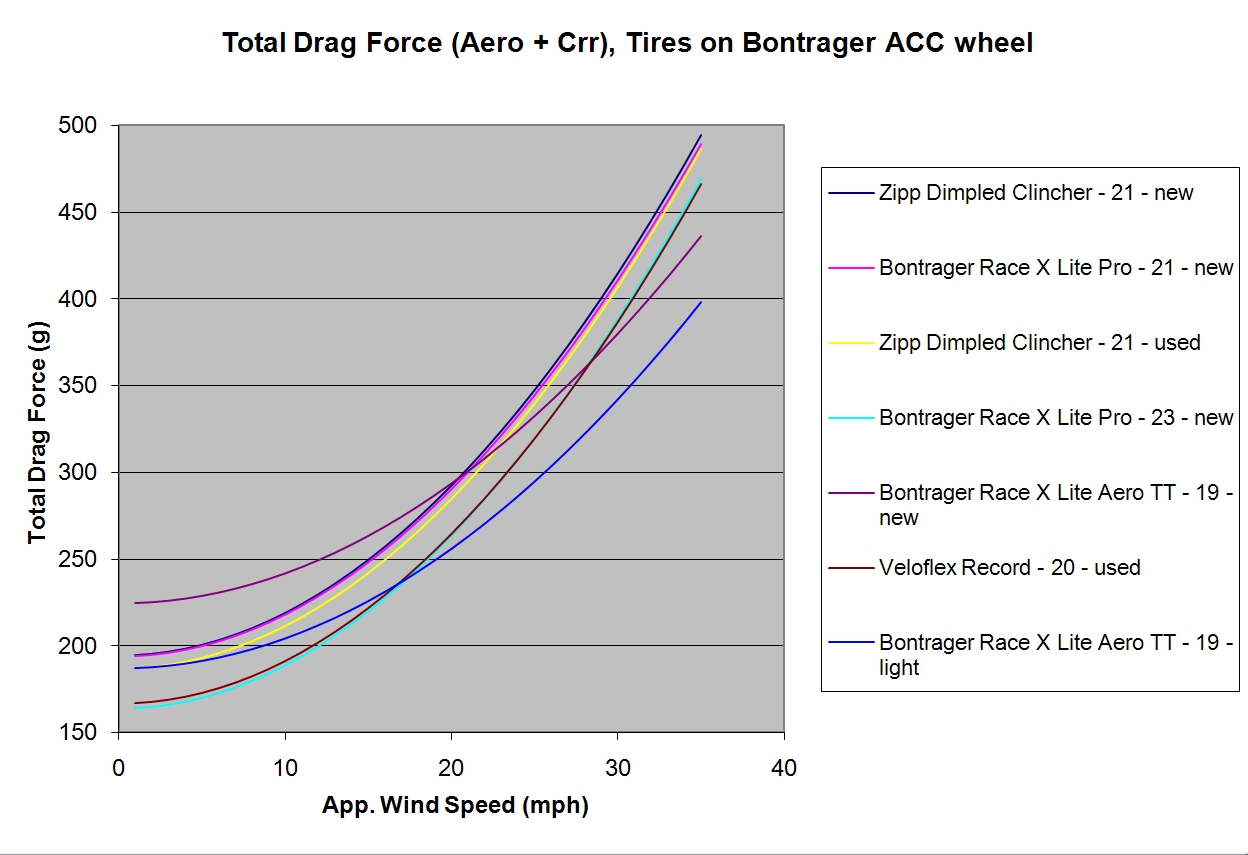
I thought that was a neat approach and reverse engineered some of his data and expanded the idea to look at the effects of varying wind speed.  In order to do so, I needed to scale the aero drag (taken at 30mph tunnel speed) to different apparent wind speeds using the ratio of V^2/(30mph^2) - since drag force varies with the square of wind velocity.  That value was then summed with the rolling resistance force, which is constant, and then the total combined aero and rolling drag was plotted as a function of expected apparent wind speed. 


Interestingly, when Trek/Bontrager released the R4 Aero tire a few years later (after Damon had left Trek to work for Vroomen/White Design) they included a plot very similar to the one I had created back in 2008:


To use that chart, you need to have an idea of what your general "race speed" is going to be and then figure out what the maximum apparent wind speed (i.e. the vector sum of the ambient wind speed at wheel level and the bike ground speed) you'll encounter.  Then you can see what the average total force you'll be expecting from a particular combination.  Now then, that's talking about the retarding force...if you want to know the power required for the different combinations, or the power differences between combinations, then you need to multiply the drag force value by the ground speed to get the rate of doing work (i.e. power) on that total drag force.  Make sense?

One of the main takeaways from that exercise above I got was that looking at JUST aero drag or JUST Crr wasn't telling the whole story.  It's very easy to "waste" a wheel/tire combination's low aero drag by using a slow rolling tire...and vice versa.  But, the other takeaway I got is that really low Crr can "make up" for a lot of less than ideal aero drag performance

Well, for the plot above, the aero drag component was taken as just a simple average of the 5, 10, and 15 degree yaw angle drags.  After seeing the plot below last fall (taken from the Mavic material given out at the CXR80 tire/wheel system introduction), I realized this type of estimate could be updated using a weighted average instead of a straight average.  The weighting would be from the expected % time spent at each yaw angle.  Obviously, we want to choose a combination based on it's performance under the conditions we expect to mostly see in our races.  If we don't see large yaw angles very often, it might not be worth it to worry about differences in performance at those higher yaw angles between the equipment choices we are contemplating.


According to Mavic, the data taken above is from actual measurements (they built a "wind vane" type rig and attached it to a bike) from a large number of rides under varying conditons and courses.  Although it may not represent the actual yaw angle distribution for any one particular ride (those will likely be skewed one direction or the other, depending on the course and conditions) but it does represent what one would expect over a large number of rides.  As such, it should be a good tool for determining a good "all around" wheel/tire system choice.

Now then, what we need to update things further is some good aero data showing the drags at various yaw angles for different tire/wheel combinations. It would be really helpful if the data happened to be for tires which I've already roller tested and have an idea of the predicted "on road" Crr.

Well, we're in luck.  The guys at Flo wheels went to the A2 tunnel last week and did just that on their new Flo30 wheel.  They tested the Michelin Pro4 Service Course, the Conti GP4000S, the Bontrager R4 Aero, and the Vittoria Open Corsa EVO Tri.  The last 2 were tires that I actually loaned them after Chris Thornham had contacted me asking if I knew of a good place to find the Bontrager tires.  I happened to have a nearly new one handy and also offered to loan one of my Vittoria tires as well.  Here's the blog post describing their tunnel visit and the aero data they took:  Flo30 Aero

As can be seen in their data, the GP4000S was the clear winner aerodynamically, with the R4 Aero close behind it.  The one tire that doesn't look too hot is the Vittoria.  Although it stays fairly close to the other tires up to ~7.5 degrees of yaw angle, after that the drag goes way up.  However, we know from my roller testing (Crr chart) that it's Crr is slightly lower than the other 2 tires, so it might be able to make up for that, especially at lower yaw angles.


 So, let's take a look. What is shown below is the result of taking a weighted average (using the Mavic probabilities for the weighting) of the drag values reported for the 3 tires that I have Crr data on (I'm working on getting a Michelin to roller test as well) combined with the Crr of each tire.  I've used the values of Newtons for the drag force (since it's an actual force unit, as opposed to grams) so that the drag force results can be simply multiplied by the expected ground speed (in meters/second) to quickly calculate the power (W).  (If you want to convert the values to grams, then just divide by 9.81 m/s - gravity - and multiply by 1000)


(Note: the above chart assumes a wheel loading of 38kg and represents a single front wheel)

There's some interesting things going on in that chart.  To understand what's going on there, it's helpful to realize that the "steepness" of each curve is controlled by the aero drag (it varies with the square of the wind velocity), while where the line sits vertically in the chart is controlled by the rolling resistance values (a constant force).

Despite the apparently poor showing of the Vittoria EVO Tri tire aerodynamically, at lower expected apparent wind speeds it actually performs slightly better than the other 2 tires shown; up until ~27 km/hr where it's curve crosses the GP4000S curve.  As compared to the R4 Aero tire, that crossover doesn't happen until expected apparent wind speeds of ~35 km/hr.  At the apparent wind speeds that I expect to see during my TT'ing (~45km/hr) the GP4000S is obviously the leader, with the R4 Aero in second, but the Vittoria still has a predicted average combined drag force that's only .21N higher than the GP4000S.  At the expected ground speed of ~42km/hr (i.e. 11.7 m/s), that results in a total power difference of just 2.5W.  That's really not a very large amount, especially considering how much worse the Vittoria appeared to perform aerodynamically.

Now then, you might be asking "why is that?"  Simply put, a lot of it has to do with the fact that the yaw angles where the largest differences in aero performance occur are also the yaw angles that are weighted less in the aero drag average due to their lower probability of being experienced.  Another interesting thing is that the differences in Crr between the Vittoria tire and the other 2 isn't very large (all within .0004 of each other), but that's enough to overcome a seemingly significantly worse aero performance.

So far we've been talking about this subject in terms of races like TTs and triathlon bike legs where the front wheel is seeing "free air"...but, what about other types of bike racing?  Well, when you're in a group and drafting, the apparent wind speed is going to be lower, along with the fact that the yaw angle distribution will narrow as well...and thus, that makes the Crr component all that more important.  If you ever find yourself in the situation of riding up a false flat in a group while using poor rolling tires, you'll understand what I'm talking about here.  Rolling resistance is actually a higher priority than wheel aerodynamics in road racing, in my humble opinion.

For one last plot, I took the data from the rest of the Flo wheels that were subsequently tested with the GP4000S tire.  That plot is shown below, and as expected at lower expected apparent wind speeds, the wheels are closer together in performance than with higher expected apparent wind speed.


There we are...I hope that helps to understand some of the tradeoffs involved with choosing tires and wheels for cycling. Of course, there are other properties further involved in these sorts of tradeoffs, such as durability and "grip", but those other properties are tough to combine into a chart like the above...and so are left up to the user to weigh separately.

Update 04/14/13:
The guys at Flo were nice enough to send me the Michelin Pro4 Service Course tire used in the aero testing above and so I got a chance to run it on the rollers.  The resultant Crr was .0043.  They also sent the Continental GP4000S used in their testing and it rolled identically to my own version of that tire at .0034.  Using that, I was able to update the Total Drag Force chart to include the Michelin on the Flo 30.  The interesting thing about the curve for the Michelin is that despite it's aerodynamics being fairly close to the GP4000S and the Bontrager R4 Aero (especially with the yaw weighting) on the Total Drag Force chart it NEVER overcomes the "hit" it takes on rolling resistance, even out to expected apparent wind speeds of 60kph.  Once again, the importance of Crr comes to the fore...


Friday, April 5, 2013

More Roller Testing Results

Well, I happened to recently acquire a Continental GP4000S tire for a very reasonable price, and in light of the recent Flo aero testing, I decided it would be a good time to throw it on the rollers and see how it does.  I also had a couple of well used "training/all condition" tires a friend loaned me so I tested those as well.  Wow...some of those training tires REALLY sap the power!

Anyway, here's the predicted on-road Crr for the 3 tires I tested today:

Continental GP4000S 23C = .0034
Specialized All Condition Pro II 23C = .0062
Specialized All Condition Armadillo Reflect 25C = .0077

The overall Crr chart now looks like this:


And here is the predicted power for 2 tires at 40kph (85kg total load):


As always, the entire spreadsheet is saved here:  Crr Spreadsheet

Tuesday, February 19, 2013

Tire Crr Testing on Rollers - The Chart..and a "how to"


In my last post I outlined the "math behind the madness" of testing the rolling resistance of bike tires on home rollers. In this one, I'll be showing the results of some of that testing I've personally done over the past year or so. I'll also go through a few tips and tricks I've learned in doing this sort of testing...just in case anyone else is crazy enough to try some of this potentially mind numbing testing.

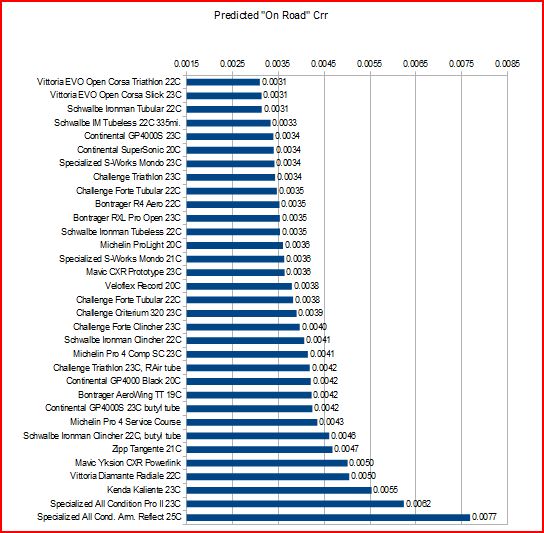
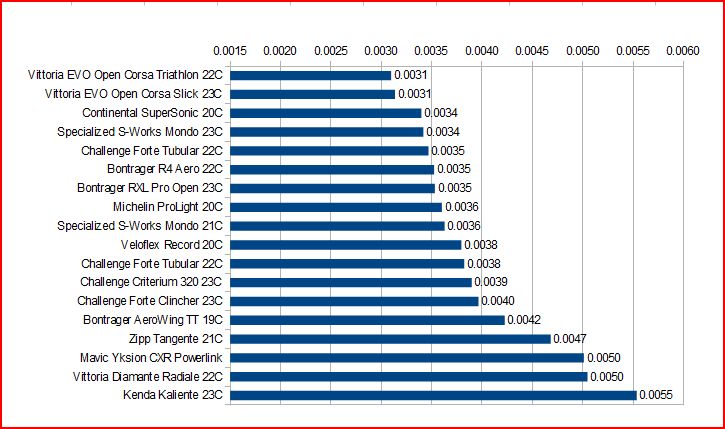
OK, I know a few of you are out there are "champing at the bit" to see the results, so without any further ado, here's a chart showing my estimates for the power to roll a pair of various tires I've tested (on a "real road" and for an 85kg bike plus rider mass):


Here's the same chart, but showing the estimated "on road" Crr values:

As can be seen, that's a fairly wide range of power requirements.  The wrong tire choice can easily "cost" a rider 10-15W of power to go a given speed.  When choosing tires, I commonly think of a scene from "Indiana Jones and the Last Crusade" where the Templar Knight guarding the Holy Grail says "...you must choose, but choose wisely...".  After all, when you're done with a race and you lose by seconds, or inches...you would hate to have the following be said about your tire choice:


The Setup:

OK, now that we've got that all out of the way, I thought I'd describe a bit about the setup I use for doing this sort of testing.  As you can see in the pic at the top of this blog post, it's a fairly simple affair consisting of a set of 4.5" diameter Kreitler rollers, a front fork stand, and a bike equipped with a power meter (and a power meter head unit).  That's really basically it.  A couple of other pieces of equipment that are crucial for getting consistent results, in my experience, are:
  • A means to measure ambient temperature
  • A means to measure rear wheel load
  • A separate speed sensor and magnet (NOT on the wheel, but on the roller - see below)
  • A notebook and pen
For measuring the ambient air temps during the test, I use my trusty Brunton ADC Summit, which I place at about axle level somewhere near the side of the rear wheel of the bike during the testing.


To measure the rear wheel load of the setup, I actually just use a digital bathroom scale which I've checked against known weights and typically is within 0.5 lbs of the actual weight.  In order to make that rear wheel load measurement, I mount the fork in the fork stand, and in stead of placing the rear wheel on the rollers, I stack the scale on top of some wood scraps and place the rear tire on the scale.  I stack it so that the rear axle is the same height off the ground as it would be on the rollers.  As it turns out, a couple of scrap pieces of 3" square wooden post and the thickness of my scale put that measurement to within 1/4" of what it is on the rollers.  Perfect.

Now then, let's talk about the speed sensor I mentioned above.  One of the most important things to get an accurate measure of in this testing is the actual "ground speed" during the test.  This can be done with a wheel mounted magnet and speed sensor, BUT that requires determining and changing the wheel rollout number for EACH tire tested.  In my experience, that can be a bit problematic...especially due to the curved contact patch that is present on the rollers.  It's very hard to get an accurate and consistent measure of wheel rollout that way.  To solve that problem, I realized that instead of triggering a speed sensor on the wheel, I could instead attach a magnet to the end of one of the rear drums and then use a speed sensor triggering off of the drum.  All I needed to do was to carefully measure the diameter of the metal drum (which will NOT be changing from test to test) and use THAT as the ground speed measurement for the testing.  Here's what that looks like:


That's just a small rare-earth magnet attached to the end cap of the roller with double-sided tape, and a Garmin ANT+ speed/cadence sensor taped to the roller frame.

Lastly, the notebook and pen are where I write down the date, what tire I'm testing, the size, the ambient temps during the testing, the power meter zero offset numbers, and the actual measured tire width as mounted.


The Protocol:

Alright, so everything is set up and we've gathered all the stuff needed.  What's next?  How do I do this? Well, here's a quick rundown of how I go about doing a tire Crr test (in "10 easy steps"!) This isn't the only way to do it, but it's how I've settled on things after doing this testing for a while:
  1. Mount the tire on the test wheel - Most of my testing is done with my old yellow-cap PT wheel with a Mavic Open Pro rim.  I started out testing with this wheel in order to get both a hub and crank power to determine the level of typical drivetrain losses in the setup.  I wanted to know that for the occasions when I would be testing tires (such as tubulars) which I couldn't mount to the clincher PT wheel. Since I'm mainly interested in tires for time trials and road racing, I'll test them using a latex inner tube.  Testing by others has shown that using a butyl tube can cause 10-15% higher Crr than with latex.
  2. Pump the tire to the test pressure - What pressure to use is really up to you.  I chose to do all of my testing with 120psi.  The reason I chose that value was mainly so that I could compare my results more easily to the results of others, most notably the testing done by Al Morrison.  Understand that on a perfectly smooth surface, the higher the pressure you pump tire up to, the lower the measured power requirements will be...however, that will only be true on the rollers, or on flat surfaces that are just as smooth.  On "real roads", i.e. roads with typical roughness, that isn't necessarily the case and there will tend to be a pressure above which higher pressures actually will make you slower overall.  Anyway, the key here is to pick a pressure and stick with it through your testing so that you are comparing tires on an equivalent basis.  
  3. Place the wheel in the test bike - Install the rear wheel in the test bike and place the chain in the chosen gear for the testing.  I do my testing in a 53x13 gear for consistency. If it's not in there already, install the fork into the fork mount.
  4. Measure the rear wheel load - This is done how I described above.  I'll usually only do this once during a session, and for me I've found it's typically within a pound or two each time (my body weight tends to be fairly stable).  This doesn't seem to be a super-critical measurement either, since a 1 or 2 lb. difference will only result in ~1-2% error in the final calculation.
  5. Place rollers under rear wheel - At this point, move the scale out from under the rear wheel and slide in the rollers. To get a consistent placement of the rear wheel on the rollers, I'll lift the fork mount slightly off the ground while I allow the rear wheel to spin as it touches the 2 rollers and then I carefully place the fork mount on the ground.
  6. Climb on board - It's now time to saddle up.  I usually approach the bike from the non-drive side and put my left foot on the pedal and then carefully swing my right leg over taking care not to disturb anything in the setup.  I'll then spin the cranks to make sure the PM is awake and the speed reading is working, at which point I'll clip out and zero the PM through the head unit.  I'll note the offset value (from my Quarq) in the notebook along with the ambient temperature.
  7. Tire warmup - Now it's time to warm up the tire to working temperature.  Since my tests are done at 90 rpm (I find it's easier to hold a consistent rpm rather than focusing on the wheel speed) I'll warm up the tire at 95 rpm for 5 minutes.  At the end of the 5 minutes, I'll stop and quickly check the PM zero offset and write the value down in my notebook along with the ambient temperature reading.
  8. The Test - Now it's time for the test.  I'll bring the cadence up to 90 rpms and once that is steady, I'll start a 4 minute interval in the PM head unit.  I'll concentrate on keeping a steady cadence through the whole interval, trying to be especially steady through the final 2 minutes since that is the section of the data I take the average power and ground speed from.  At the end of the 4 minute test interval, I'll again note the PM offset (to make sure it hasn't moved appreciably during the test for some reason) and write down the ambient test.  That's it.  Test over...either I stop there, or if I have more to tires to test, I'll start back at step one (skipping the load measurement for repeat tests) and on through the remaining steps.
  9. Download Data - Now it's time to get the average power and ground speed values from the head unit.  I'll typically load the file into Golden Cheetah and then highlight the final 2 minutes of each test session and read off the averages as calculated.
  10. Calculate the Crr - The final step is to take the average power and speed values, along with the wheel load and ambient temperature taken at the end of the test interval into a spreadsheet I've written to quickly do the calculations.  I've loaded the spreadsheet onto Google Drive and it can be accessed here: Crr Spreadsheet
Other Notes:
  • After doing a number of runs using both the crank-based power meter and the PT wheel, I was consistently finding that for the gearing chosen and the lower power levels (typically 50-100W) seen on the 4.5" rollers, the drivetrain losses were on the order of 5%.  That's the value I enter in the spreadsheet.
  • I did a fair number of runs with the exact same tire and at different ambient temperatures to determine what I should use as the temperature compensation value.  In my case, I found it to be ~1.36% change per deg C (lower Crr with higher temperatures).  Here's the plot of those tests:

  • I normalize the Crr values to 20C.  If you want to know what the Crr would be at various temperatures, you can just enter those temperatures into the appropriate cell on the first sheet of the spreadsheet.
  • Added 2/19/12 - I realized I forgot to point out that I use a "smooth to real road" factor of 1.5X to account for the higher energy dissipation requirements of typical road roughness.  This value is based on comparisons of roller based Crr measurements ("translated" to flat surface) and actual "on road" Crr derived from field tests and other means (i.e. iAero coast down values) for the same tires.

Well...that's about all I can think of for now.  Hopefully that will help encourage others to give this a try.  It's really not that difficult to do and is a good way to help you to "choose wisely" when it comes to tires for your "go fast" bike setup.

Friday, February 1, 2013

LeMond Power Pilot - Does it give good numbers?


Considering that it was announced today that Greg LeMond had formed a new venture to sell the Revolution trainer, and that my last post had dealt with the Revolution, I thought it would be a good time to also talk about the Power Pilot device that LeMond sells for use with the trainerIf someone already has a non-wheel based power meter on their bike, then the Power Pilot would be a bit redundant.  But, for those who use a PT wheel primarily, or don't have another form of power measurement, the Power Pilot could be a good alternative for determining the "load" during a trainer workout.  The following is a brief look at the power reporting and recording performance of the LeMond Power Pilot. In particular, it is compared to the output of a “known good” Quarq CinQo crank-based power meter.  "Known good" in this sense is a power meter which has had it's torque slope checked and adjusted and has a zero offset that is stable.


BACKGROUND

The LeMond Power Pilot is a device designed to be used in conjunction with the LeMond Revolution trainer to primarily monitor and record the training efforts of the rider. The Revolution trainer is a high inertia wind trainer with the somewhat unique configuration whereby the rear wheel of the attached bike is removed and is not a part of the driven assembly. The chain of the bike drives a rear cassette which is attached to a relatively high mass flywheel through a belt drive gear reduction system. In my last blog post ("What's the Virtual CdA and Crr of the LeMond Revolution Trainer"), it was shown that this system “mimics” the aero drag of a typical sized rider on a road bike (CdA = ~0.35 m^2) and the rolling resistance of average tires (Crr = ~ .005). The inertial mass was also found to be equivalent to a rider mass of ~45kg, which although it is less than the mass of a typical rider, it is far higher than the much lower inertial masses of most indoor trainers on the market today. This accounts for the often reported excellent “road feel” of the Revolution trainer.


The Power Pilot uses an ANT+ sensor to read the drive pulley rotational velocity, and by extension, the flywheel speed during operation. Along with the known aero properties of the flywheel fan, the aero drag power is calculated using that speed measurement and an estimate of the air density (based upon the user entered altitude, an internal temperature sensor, and an internal humidity sensor.) The speed sensor is also used to determine the acceleration/deceleration of the flywheel mass to account for that in the power reporting. Additionally, the Power Pilot firmware allows for a coastdown calibration to be performed which then accounts for any unit to unit variation in the “fixed” losses of the mechanism.


THE TEST AND RESULTS

In order to determine how well the Power Pilot performs these calculations, it was decided to compare the Power Pilot output to the power values measured using a Quarq CinQo crank-based power meter. The particular CinQo used in this testing is a “known good” unit which has been recently calibrated for torque slope and demonstrates a very stable zero offset. To make the comparison, a ride was undertaken whereby a “cassette sweep” was performed. The ride started with the bike in a gear selection of 53/25 and then progressed down the cassette every ~1.5 minutes until a gear selection of 53/12 was used, all the while keeping a constant 60 rpm cadence. Then, the chainring was shifted to a 39T and the progression was repeated partially up the cassette. Finally, two additional runs were taken at a higher cadence (and thus power). A plot of both power traces vs. time is shown below:


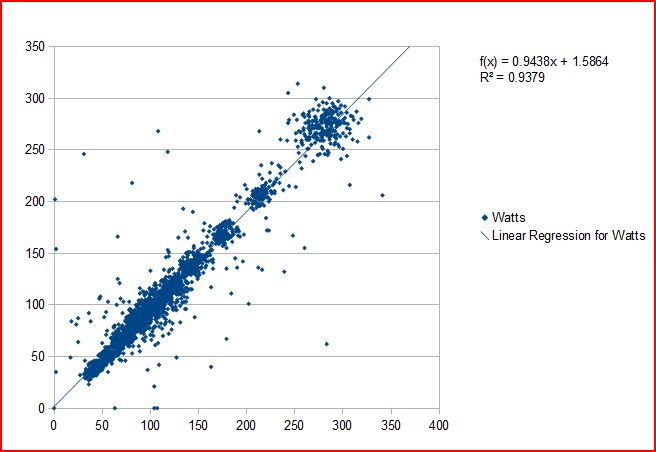
Looking closely, one can see that aside from a slight offset, the values reported by each power meter “track” very closely to each other. This can further be seen if the power values relative to each other are plotted on a point-by-point basis. The plot below shows the power reported at each point in time with the CinQo power values on the x-axis and the Power Pilot values on the y-axis.


Typically, due to factors such as variations in recording rates, calculation algorithms, etc. the sort of plot above doesn't turn out very well as a comparison tool for power meters. However, in this case, the point-by-point power reporting is fairly good and it appears that the Power Pilot reports ~94% of the power reported by the CinQo. Considering that the Power Pilot estimate is taking place “downstream” of the bicycle drivetrain losses (much like a PowerTap wheel) in comparison to the crank-based location of the CinQo, a ~6% drivetrain power loss is reasonable, and typical of an average drivetrain.


Rather than looking at the point-by-point plot and it's curve fit, often it's more useful to look at a plot of the averages reported by the power meters over constant power sections. The plot below is the same as the previous plot, but the averages over each of the “intervals” of the cassette sweep are plotted and a curve is fit to them. As can be seen the fit is fairly “tight” to the data and the slope of the fit (i.e. the drivetrain loss) is similar to that reported above, albeit slightly lower. This appears to point out that the correlation between the 2 devices may be slightly better during constant power efforts. Alternatively, it could reveal that the time correlation of the point-by-point data looked at above may be slightly “off”.


However, understanding where the power meters don't agree can sometimes be much more enlightening in that it can reveal systemic difference between the devices. One tool for doing this is something called a “Mean – Difference” Plot. This plot shows the difference between the power values reported by the 2 devices plotted against their average. The Mean-Difference plot of this ride is shown below:


The things to look for in this type of plot that reveal systemic “issues” are characteristics like the spread of the points getting larger or smaller with the mean power values or the difference not trending in a monotonic fashion. Neither of these types of issues appear to be present above, implying that the Power Pilot “agrees” with the CinQo output in a consistent and predictable manner.


Another area of interest for comparisons of this type is how the 2 devices respond to sprint type efforts. An additional ride was undertaken where a pair of short sprints were performed in order to see if there were any anomalies between how each device reported these efforts. As can be seen below, the shapes of the curves are very similar with the peak values also being very close to each other.


CONCLUSIONS

This brief examination of the power output of a LeMond Power Pilot on a Revolution trainer shows that it does an acceptable job at determining and recording the rider's power output when compared to a “known good” crank-based power meter. The power output is similar to what one would expect to see from a hub-based power meter, which is favorable for the likely customer base for this product, namely users with no other power meter or Power Tap owners who want to train indoors with and/or by power.